
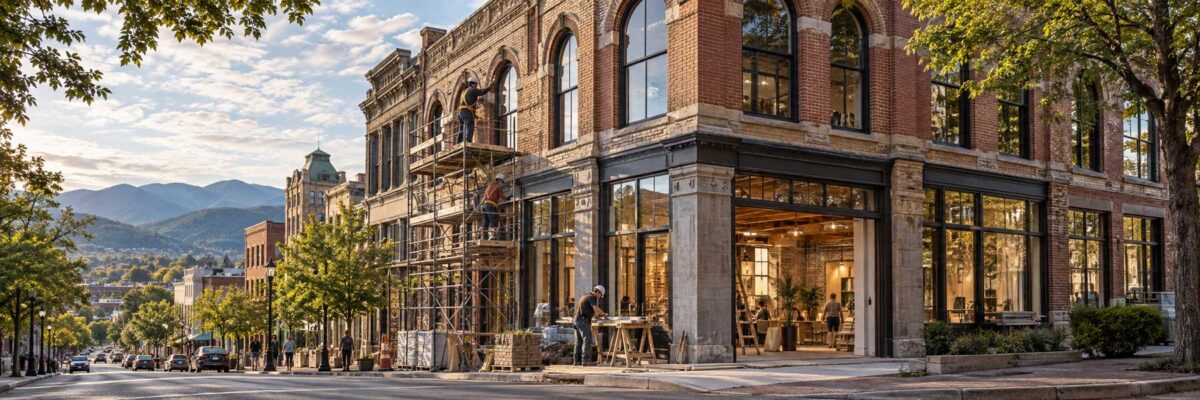
Asheville is full of buildings that have outlived their original purpose but not their potential. A century-old commercial storefront, a mill building repurposed for offices, a flood-damaged property waiting for its next chapter — these structures carry character that new construction can’t replicate, along with a set of challenges that require a different kind of construction expertise.
At Falcon Construction and Development, historic restoration and adaptive reuse make up a meaningful part of our work throughout Asheville and Western North Carolina. Here’s what property owners should understand before taking on a project like this.
What Makes These Projects Different
Restoring or repurposing an existing structure isn’t simply construction in reverse. It starts with understanding what’s actually there — structural condition, code compliance, hidden systems, and the layers of history (and sometimes surprises) inside the walls. That discovery phase shapes everything that follows: scope, budget, and timeline.
A few of the considerations that come up on nearly every historic or adaptive reuse project:
✔️ Structural assessment — what’s sound, what needs reinforcement, and what has to be replaced
✔️ Code compliance for current use — especially when a building is changing from one purpose to another (residential to commercial, for example)
✔️ Preserving character-defining features — facades, materials, and details worth protecting
✔️ Updating systems — electrical, plumbing, and mechanical brought up to current standards without compromising the structure
✔️ Sequencing work around what you find — historic buildings rarely reveal everything up front
A Project in Progress: 12 Brevard
We’re currently working on 12 Brevard, a commercial building more than 100 years old, being transformed into three functional commercial spaces. Projects like this reinforce a pattern we see often: the building tells you what it needs once work begins, and the plan has to be able to adapt without losing momentum or budget discipline.
When Restoration Meets Disaster Recovery: Gemelli
Not every adaptive reuse project starts from a place of opportunity. Gemelli, our restaurant build-out in Biltmore Village, began after more than 11 feet of floodwater from Hurricane Helene devastated the property. What followed combined historic restoration with a complete restaurant upfit — preserving the character of a building that has stood for more than a century while rebuilding it into something new. The project was later recognized with a 2026 Griffin Award, shared with the many partners who helped bring the Biltmore Village landmark back.
Why Existing Buildings Are Worth a Second Look
New construction isn’t always the better answer, especially in a market like Asheville where character, location, and zoning history can be difficult or impossible to replicate. Adaptive reuse and historic restoration can offer:
✔️ Character and history a new building can’t provide
✔️ A head start on location and zoning that would be difficult to secure otherwise
✔️ A sustainability advantage — reusing structural material rather than starting over
✔️ Often (though not always) a faster path than ground-up construction in tightly zoned areas
Our Approach
Whether it’s a historic commercial building being adapted to a new use or a property recovering from storm damage, the same principles apply: transparent budgeting as scope becomes clearer, open communication as decisions come up, and coordination across the trades and specialists these projects require.
Considering a restoration or adaptive reuse project in Asheville or Western North Carolina? We’d welcome the conversation.
falconbuilt.com/contact-us/